
Wenzhou-Kean University Valedictorian Address 2026
Class of 2026 Commencement Address
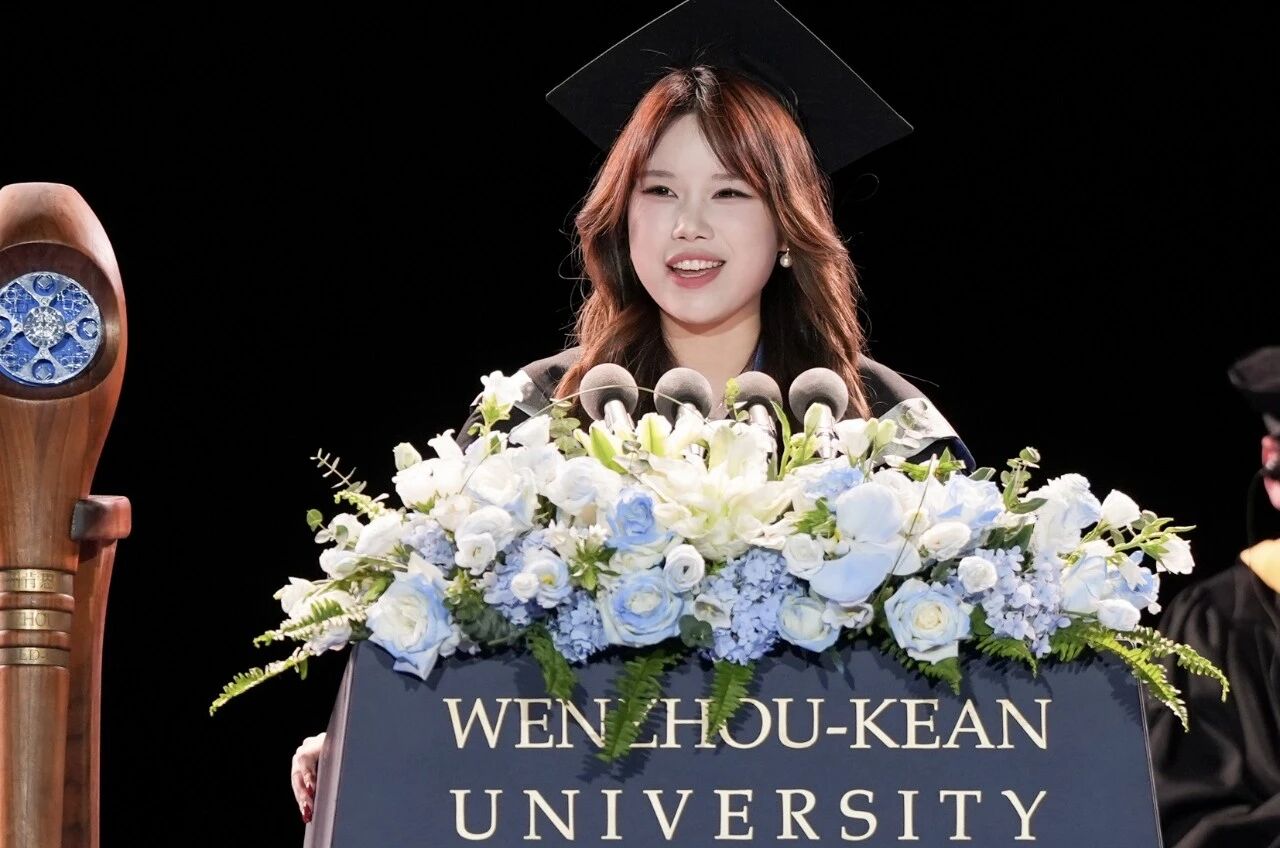
Speech by Ms. Fu Yuxi (undergraduate)
Ladies and gentlemen, esteemed faculty, and my fellow graduates,
Good afternoon. I am Fu Yuxi, and it is an honor to stand here today on behalf of the Class of 2026.
But before I begin, I want to start with an honest confession.
I was a timid person. When I was little, I once cried at an amusement park because I was too scared to ask for popcorn. In middle school, even teachers called me a pushover. I said yes to everything, smiled at everything, and was afraid to speak up.
I arrived at WKU carrying all of that.
Then came a journalism assignment. I had to interview a local shop owner. I reached out to his assistant, rejected. I showed up in person, rejected again. I went back into the elevator and was ready to leave.
When the doors closed, I cried, the way I always had.
But when the doors opened, somehow, I found the courage to go back and found him again maybe because I was tired of always walking away, or maybe, at WKU, I began to see courage in people around me. This time I didn’t just ask, I told him why the story mattered, and why he was the right person to tell it with. He looked at me for a moment and agreed.
It is not a big story, but I always remember the courage that pushed me out of that elevator. In four years, I started to compete in national speaking and debate competitions. I organized events, stood in front of rooms full of people, and each time became a little braver, a little clearer about what I wanted to say.
I think you all know exactly what that elevator felt like. Maybe for you, it was a rejection letter, a failed exam, or a version of yourself you had to let go of before you could grow into the next one.
As my favorite author, Hermann Hesse, wrote, “Who would be born must first destroy a world.” WKU was where I destroyed mine, the old version of myself I had assumed was fixed.
We all have an elevator. What WKU taught us is to step out of it.
So, if I had to name what these four years gave us, it would be three things.
First, we learned how to speak and to have something worth saying. We stopped translating between two languages and started actually thinking in both. We brought our voices to national competitions, to international screens, to exhibitions that introduced Wenzhou's traditional arts to the world. We learned that speaking up is not about being the loudest in the room. It’s about having something real to say and the courage to say it.
Second, we learned how to inquire and stay uncomfortable with easy answers. From research labs to AI conferences, from business case competitions to international academic forums, we stepped into spaces that were challenging. I still remember one of my communication professors encouraging me, when I was applying for graduate school, to aim higher, and when I was writing my thesis, to dig deeper. That willingness to go further was what WKU trained in us.
Third, we learned responsibility. We didn’t just study the world. We started caring about it. About sustainability, inequality, and the kind of future we are building. Our students debated these questions in classrooms, researched them in labs, and brought them into real practice. WKU gave us the knowledge and the platform. And it is time for us to use them to build a better world.
None of this happened alone. To the staff and faculty who made this campus feel like home, thank you. To our professors, thank you for your patience, guidance, and belief. To our families, thank you for carrying us farther than we realized and for making it possible for us to be here today. Especially to my dad, who always knew how to make me laugh when I needed it most, and my mom, who never once stopped supporting me, thank you. And to our friends, thank you for sharing these four years with us.
And now, to us, the Class of 2026:
We are researchers who ask difficult questions and never give up on finding answers.
We are bridge-builders between East and West, between tradition and innovation, and between who we were when we arrived and who we became.
And above all, we are WKUers: people who dare to show up, stay curious, and keep pushing forward.
Now, we are graduating into a world full of uncertainty. Nobody is handing us a map. But we have spent four years learning how to navigate without one.
Happy graduation. Thank you.
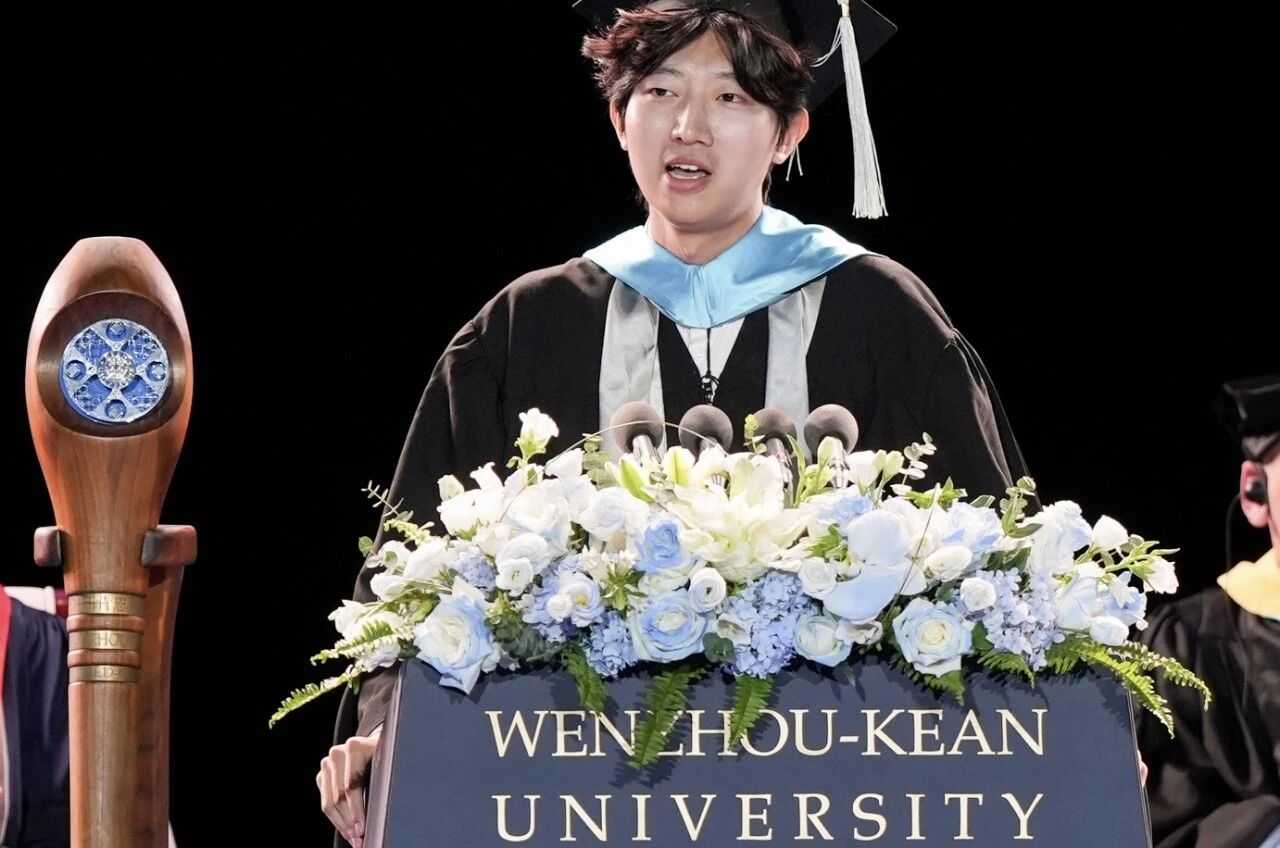
Speech by Mr. Wu Jiajun (graduate)
Distinguished guests, faculty members, and the Class of 2026, good afternoon.
Before I begin, I just want to take a moment to thank everyone who made today possible, especially the groundskeepers, volunteers, and staff.
And to our faculty, my fellow graduates, and the families who have supported us along the way and are here today, we are so grateful to have you with us.
Today feels like both an ending and a beginning.
I want to take you back to a night during my first month at Wenzhou-Kean. I was sitting in my dorm, tired and a little overwhelmed. I turned on my VPN, opened ChatGPT, and typed, “Write an abstract for a paper on organizational change in schools.”
Within seconds, a clean and well-structured paragraph appeared.
I remember thinking, this is amazing. My life just got so much easier.
So, I began using it more often. I asked AI for outlines, presentations, and even email drafts. At the time, I felt efficient and even a little proud, as if I were staying ahead of the curve.
But gradually, something changed.
One day in class, my professor asked us to share our own views on school-based curriculum development. The first thought that came to mind was to ask AI.
That was the moment I realized something was wrong. It was no longer just a tool. I was beginning to step away from my own thinking.
I opened my notebook and found only blank pages. For the first time, I understood that I was not simply saving time. I was slowly giving up my ability to think independently.
Have you ever felt that? You become more efficient, yet somehow feel less certain of yourself.
I decided to stop using AI for a while.
One afternoon, I sat in the library for two hours and wrote three sentences.
Just three. I started to question myself. If AI could do everything better, what is the point of me?
After some time, I came to a realization. The real risk of technology is not that it replaces us, but that it quietly leads us to stop thinking without us even noticing.
That realization changed my approach.
Instead of treating AI as a shortcut, I began to use it as a partner. I would first develop my own ideas, then use AI to identify gaps or improve clarity. The process was slower and sometimes frustrating, but gradually, something returned. My voice, my thinking, and my confidence.
As a student of Educational Administration, this experience led me to reflect on a broader question. What should education truly prepare us for in a world where AI can perform so many tasks?
AI can generate lesson plans quickly, but it cannot guide a student in discovering their own interests.
It can analyze large amounts of data, but it cannot notice the quiet student who is almost ready to speak.
Education has never been only about answers. It is about curiosity, struggle, and growth. These are not things we can hand over to technology.
So today, I would like to leave you with one simple idea. Do not outsource your mind.
Do not hand it over to technology, to convenience, or to the pressure to always be efficient. The value we bring to the world lies not in how quickly we produce answers, but in how deeply we think, how honestly we question, and how willing we are to grow.
Maybe our generation does not need to compete with technology.
Maybe our real responsibility is to decide what we will use technology for and what we will choose to hold onto as humans.
Wenzhou-Kean has given us something meaningful. It is a place where we are encouraged to ask questions and to think critically. Many of us remember being asked again and again, “How do you know?”
It is also a place where disagreement was not failure but part of learning, and where thinking for yourself was not optional but expected.
And that is something no machine can replicate.
So, as we walk out of here today, into a world that will only get faster, smarter, and more automated, I hope we choose something different.
I hope we choose to slow down sometimes, to think for ourselves, to stay curious, and to stay human.
Congratulations, Class of 2026.
Wherever life takes you, take your mind with you.
Thank you.
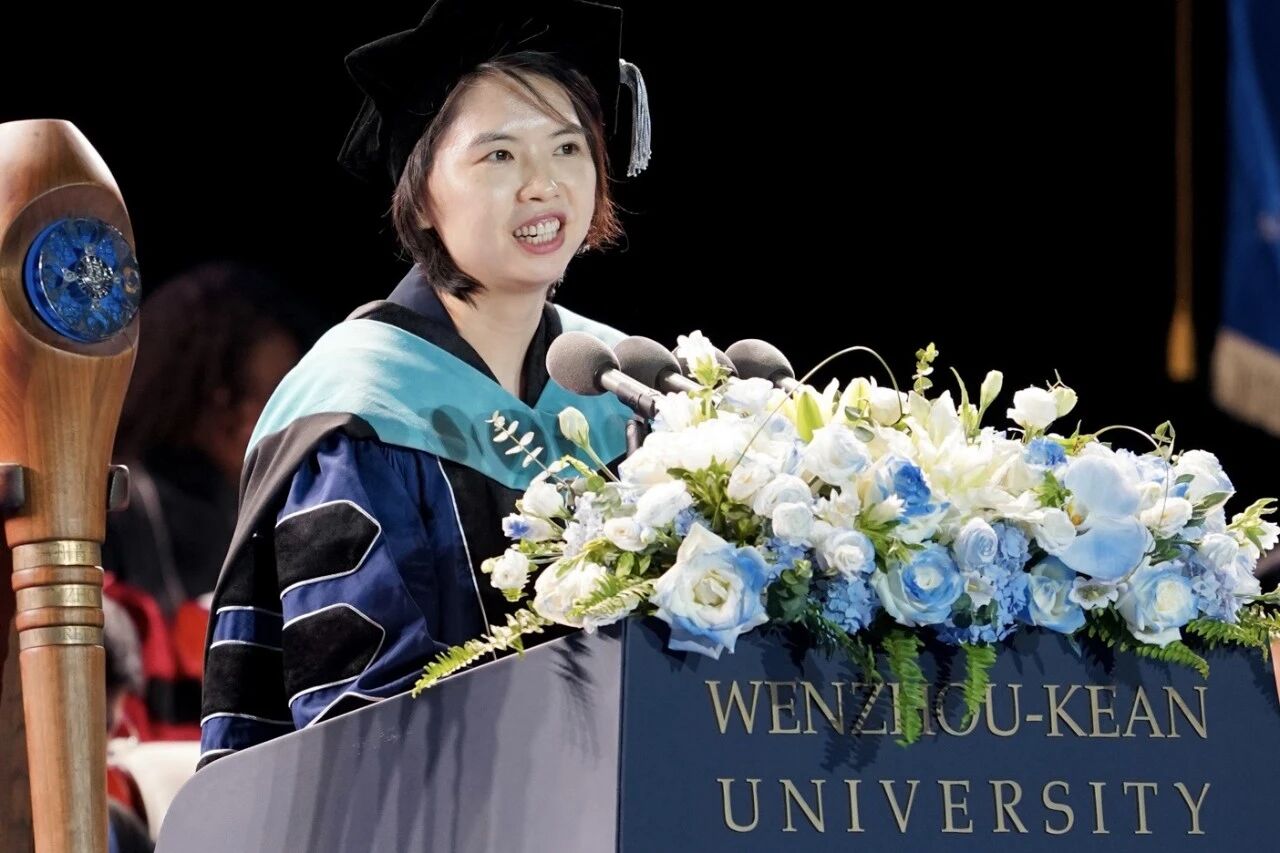
Speech by Ms. Chen Wenping (doctoral graduate)
Distinguished university leaders and faculty, dear family members and friends, and fellow graduates of the Class of 2026:
Good afternoon.
It is a great honor to stand here today as a representative of the doctoral graduates.
As we celebrate this milestone, I have been reflecting on a simple question: What will we carry with us when we leave Wenzhou-Kean University?
Each of us has followed a different path. We come from different professions, disciplines, and life experiences. Yet over the past four years, we have shared the same journey of questioning, learning, and growing together.
Today, I would like to share three gifts that I believe many of us are taking with us from this journey.
The first gift is a global vision grounded in local realities.
Before joining this program, I spent fifteen years working in the field of economics. Having studied Economics and Finance at the London School of Economics and Political Science, I was trained to think in terms of efficiency, incentives, and measurable outcomes.
Like many doctoral students, I entered this program believing that leadership begins with expertise. Yet through our studies, research, and field experiences, we came to understand that educational leadership begins somewhere deeper—with people, communities, and the realities they face every day.
For me, educational leadership is no longer an abstract concept. It is the road a mountain child takes to school. It is the dedication of a rural teacher who continues to serve despite challenges. It is the daily effort to make educational opportunity more equitable and accessible.
Wenzhou-Kean taught us that global perspectives matter most when they help us respond to local needs.
The second gift is the ability to seek evidence while never losing sight of meaning.
When I began my doctoral research, my first instinct was to rely on quantitative methods and statistical models. But one question from my professors stayed with me: What do those numbers mean when placed before the growth of a child or the future of a school?
That question challenged me to think differently.
As researchers and practitioners, we learned the importance of data, evidence, and systematic thinking. But we also learned that education cannot be understood through numbers alone. Behind every dataset are human stories. Behind every policy are students, teachers, and families whose lives are affected by our decisions.
Wenzhou-Kean University taught us that evidence helps us make better decisions, but purpose helps us make the right ones.
The third gift is a commitment to lead with humanity and a long-term vision.
Over the past four years, we balanced careers, families, research, and study. We supported one another through deadlines, challenges, and moments of uncertainty. Along the way, our professors challenged our assumptions, expanded our perspectives, and demonstrated what genuine leadership looks like.
Today, we enter a world shaped by rapid technological change. Artificial intelligence is transforming how knowledge is created and shared. Demographic shifts are reshaping educational systems and communities.
Yet amid these changes, one truth remains constant: education is, and will always be, a profoundly human endeavor.
No technology can replace the trust between teacher and student. No algorithm can fully capture the hope that education brings to a family or a community.
As educational leaders, our responsibility is not only to manage change, but also to ensure that change serves people.
As I return to my work in Yongjia, I carry these three gifts with me. I know many of my fellow graduates will carry them into schools, universities, communities, and organizations across different regions and sectors.
Different paths await us, but the lessons we have learned here connect us.
After four years of study, I have come to believe that leadership is not defined by titles, authority, or position. Leadership is the ability to help others discover their potential, pursue their aspirations, and create opportunities for growth.
That, perhaps, is the most important lesson Wenzhou-Kean has given us.
Class of 2026, wherever our journeys lead next, may we continue to connect the global with the local, balance evidence with purpose, and lead with humanity.
Congratulations to the Class of 2026.
Thank you.
- Wenzhou-Kean University Secures Joint First Place in Zhejiang with Three Intangible Cultural Heritage Projects

- University–Industry Collaboration Earns International Recognition Again! WKU Interdisciplinary Project Wins the Red Dot Award: Design Concept
- The 4th Zhejiang-New Jersey STEAM Innovation Education Conference held at Wenzhou-Kean University

